
Polymarket Prediction Bot Development for Crypto (2026 Guide)
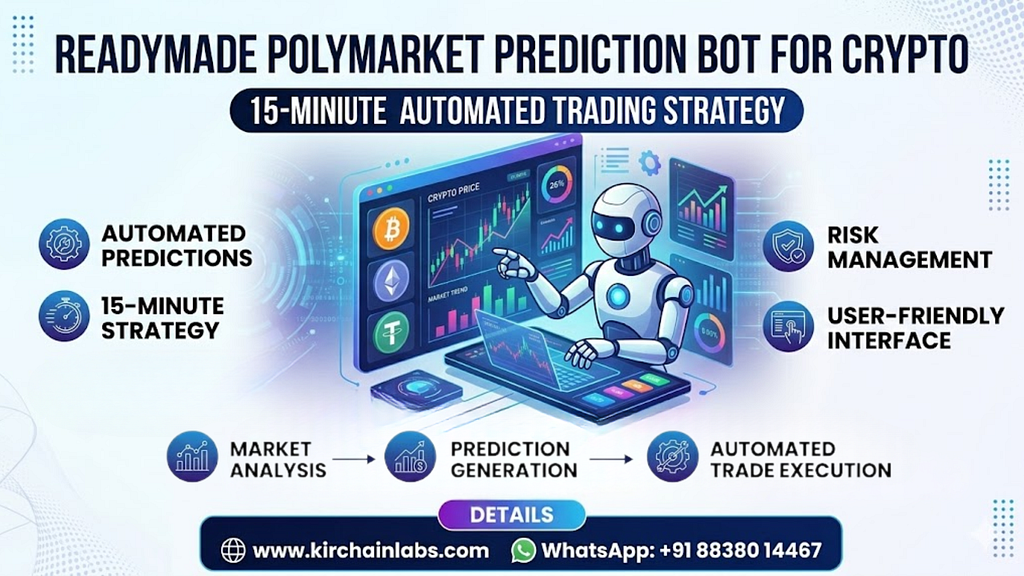
Polymarket prediction bot development for crypto is rapidly emerging as one of the most advanced segments in decentralized finance automation.
As blockchain-based prediction markets surpass $5+ billion in annual trading volume (2025 industry reports) and short-duration contracts like 15-minute markets gain momentum, automated systems are shifting from optional tools to competitive infrastructure.
During high-impact political and crypto volatility cycles, single-event volumes have exceeded $100 million, demonstrating institutional-scale liquidity. With this scale, participation is no longer about speculation alone — it is about structured execution, speed, and probability modeling.
This guide explains how Polymarket prediction bots operate, why micro-duration markets are expanding, how AI enhances forecasting accuracy, what risks must be managed, and how businesses can strategically enter this sector.
The Growth of Prediction Markets in CryptoPrediction markets allow participants to trade the probability of real-world outcomes. Instead of buying tokens, users purchase “Yes” or “No” shares tied to specific events — elections, economic data releases, crypto price levels, regulatory decisions, and more.
Several macro factors are accelerating adoption:
- Stablecoin circulation exceeded $150 billion globally in 2025
- Layer-2 scaling reduced transaction costs by up to 80% during congestion
- Institutional interest in decentralized forecasting tools continues to rise
- Event-driven financial instruments are gaining mainstream awareness
Behavioral economics research suggests prediction markets often outperform traditional polling models because they aggregate financial incentives with information accuracy. This credibility has increased their relevance within fintech and quantitative research communities.
As liquidity deepens, efficiency improves — and inefficiencies become shorter-lived. That is where automation becomes critical.
Why 15-Minute Prediction Markets Are Expanding RapidlyModern traders increasingly favor short-duration markets that resolve quickly. Micro-markets align with digital behavior patterns — fast, responsive, and information-driven.
Short-duration contracts offer:
- Faster capital rotation
- Reduced overnight exposure
- Higher trading frequency
- Volatility windows driven by real-time information
In 2025, platform data showed that contracts under one hour experienced nearly 40% higher trading frequency compared to long-term event markets.
For automated systems, this creates repeatable micro-opportunities. When probability pricing lags behind breaking information, even brief inefficiencies can present structured entry points — provided execution is immediate.
What Is Polymarket Prediction Bot Development for Crypto?Polymarket prediction bot development refers to designing intelligent automated systems that participate in decentralized event markets without manual intervention.
Instead of relying on human reaction time, these bots:
- Monitor hundreds of live markets simultaneously
- Detect temporary probability mispricing
- Execute Yes/No trades directly on-chain
- Dynamically manage capital exposure
- Track performance metrics for continuous optimization
Unlike traditional crypto trading bots — which focus on candlestick patterns, support/resistance zones, or momentum indicators — prediction bots analyze a different data structure:
- Implied probability shifts
- Liquidity imbalances
- Order book depth
- Capital concentration across outcomes
- Information asymmetry between early and late participants
For example, if a market reflects a 48% probability and breaking information suggests a more realistic probability of 63%, the window before full price adjustment may last seconds — particularly in 15-minute contracts.
In this environment, automation is not about convenience. It is about latency-sensitive execution and structured probability evaluation.
Automation vs Manual Trading: The Statistical AdvantageEven highly experienced traders face one unavoidable constraint: human limitation.
Research in algorithmic trading consistently shows:
- Automated systems execute trades up to 100x faster than human reaction cycles
- Emotion-driven decisions account for a substantial portion of avoidable retail trading losses
- High-frequency automated systems represent over 70% of trading volume in traditional financial markets
Prediction markets differ structurally from equities or derivatives, but the foundational advantage remains consistent: speed, discipline, and rule-based execution outperform emotional reaction in short-duration environments.
Automation transforms event trading from reactive speculation into structured probability management.
Technical Architecture of a Professional Prediction BotTo operate efficiently in high-volume event environments, prediction bots require layered architecture.
1️⃣ Data Intelligence LayerThis layer aggregates and synchronizes real-time inputs:
- Polymarket API integration
- Blockchain event monitoring
- News feed ingestion
- Social sentiment tracking
- Liquidity depth analysis
In micro-duration markets, pricing inefficiencies may last only seconds. Latency reduction is therefore mission-critical.
2️⃣ Statistical & AI Strategy EngineThe strategy engine applies:
- Bayesian probability modeling
- Historical pattern evaluation
- Liquidity sensitivity mapping
- Volume anomaly detection
Advanced systems incorporate:
- Natural Language Processing (NLP) for breaking news interpretation
- Sentiment scoring across crypto communities
- Reinforcement learning for adaptive optimization
According to fintech AI adoption reports, over 60% of institutional trading firms integrate machine learning into execution frameworks. Prediction markets are increasingly aligning with this trajectory.
3️⃣ Execution & Blockchain Interaction LayerExecution modules manage:
- Smart contract communication
- Gas fee optimization
- Slippage control
- Transaction confirmation monitoring
With Layer-2 scaling solutions significantly reducing transaction costs and confirmation times, execution efficiency has improved markedly in recent years.
4️⃣ Risk Management FrameworkBinary event markets carry asymmetric risk — if the outcome resolves against the position, capital allocation can be fully impacted.
Professional bots mitigate exposure using:
- Per-event capital allocation limits
- Cross-market diversification
- Correlation filtering
- Dynamic exposure scaling
- Drawdown protection thresholds
Long-term sustainability is built on controlled risk rather than aggressive exposure.
Realistic Profitability: A Data-Driven PerspectiveOne of the most common questions is:
Is Polymarket prediction bot trading profitable?
Profitability depends on:
- Liquidity depth
- Strategy robustness
- Execution latency
- Event volatility
- Capital discipline
Market microstructure research shows short-term inefficiencies occur most frequently during high-volatility information releases. However, sustainable performance comes from:
- Repeated small statistical advantages
- Portfolio diversification
- Strict capital preservation
- Continuous model refinement
No automated system eliminates risk. It systematizes it.
Business Opportunities in Prediction Bot DevelopmentAs decentralized prediction markets exceed multi-billion-dollar annual volumes, infrastructure demand continues to expand.
Entrepreneurs and fintech builders are launching:
- White-label prediction trading platforms
- SaaS-based automation services
- Institutional analytics dashboards
- AI-driven event forecasting APIs
The global algorithmic trading software market is projected to grow at a CAGR above 10% through 2030, reflecting sustained automation demand.
Prediction bots operate at the intersection of:
- DeFi infrastructure
- AI analytics
- Event-driven finance
- Blockchain automation
This convergence creates long-term commercial potential.
Cost of Polymarket Prediction Bot DevelopmentThe cost of Polymarket prediction bot development varies significantly depending on the system’s complexity, feature set, scalability requirements, and level of AI integration.
A basic automation tool designed for limited market participation will require a smaller investment, whereas an enterprise-grade, AI-powered, multi-market trading infrastructure demands considerably more technical depth and resources.
Key cost drivers include:
- AI model integration for forecasting and sentiment analysis
- Multi-market scanning architecture for real-time monitoring
- Enterprise analytics dashboards with backtesting modules
- Security audits and smart contract testing
- Cloud infrastructure and redundancy systems
- Ongoing maintenance and optimization
Enterprise solutions emphasize:
- Scalability for high trading volumes
- Secure key management and encryption
- Infrastructure resilience during volatility
- Regulatory awareness in evolving jurisdictions
Investment reflects strategic intent — whether building a private trading system or a commercial SaaS platform.
Key Risks to ConsiderDespite strong growth, prediction markets carry inherent risks:
- Oracle resolution delays
- Liquidity shortages
- Sudden probability reversals
- Smart contract vulnerabilities
- Regulatory evolution
Professional development integrates mitigation strategies at the architectural level.
The Future of Event-Based Crypto Automation (2026–2030)Automated event trading represents a structural shift within decentralized finance.
Between 2026 and 2030, prediction markets are expected to evolve into structured forecasting ecosystems supported by:
- AI-powered probability recalibration
- Cross-chain liquidity routing
- Institutional exposure dashboards
- Faster modular blockchain settlement layers
As decentralized infrastructure matures, event-based instruments may emerge as a recognized asset class within digital finance.
Prediction markets convert information into tradable probabilities. In a world defined by rapid data exchange and geopolitical volatility, structured forecasting becomes strategically valuable.
Automation will not merely enhance participation — it will define competitiveness.
ConclusionThe expansion of prediction markets signals a broader evolution within decentralized finance. As liquidity deepens and micro-duration contracts gain popularity, intelligent trading infrastructure becomes essential.
Modern prediction bots integrate data engineering, statistical modeling, blockchain execution, and disciplined capital controls into unified systems designed for latency-sensitive environments.
For startups, fintech innovators, and enterprises entering this space, technical precision matters. Secure smart contract interaction, scalable cloud deployment, AI-enhanced probability modeling, and robust risk management must function seamlessly during high-impact market events.
KIR Chain Labs, a globally recognized crypto trading bot development company with over 10 years of blockchain expertise and 2500+ projects delivered across 80+ countries, provides specialized Polymarket Prediction Bot Development services. Their team builds secure, scalable, AI-driven automation systems tailored for decentralized event markets — enabling businesses to enter this emerging sector with confidence and long-term strategic advantage.
As digital forecasting platforms mature, organizations equipped with advanced automation capabilities will be positioned to lead the next phase of event-driven finance.
Polymarket Prediction Bot Development for Crypto (2026 Guide) was originally published in Coinmonks on Medium, where people are continuing the conversation by highlighting and responding to this story.