
Meet the world’s smallest AI supercomputer that fits in your pocket
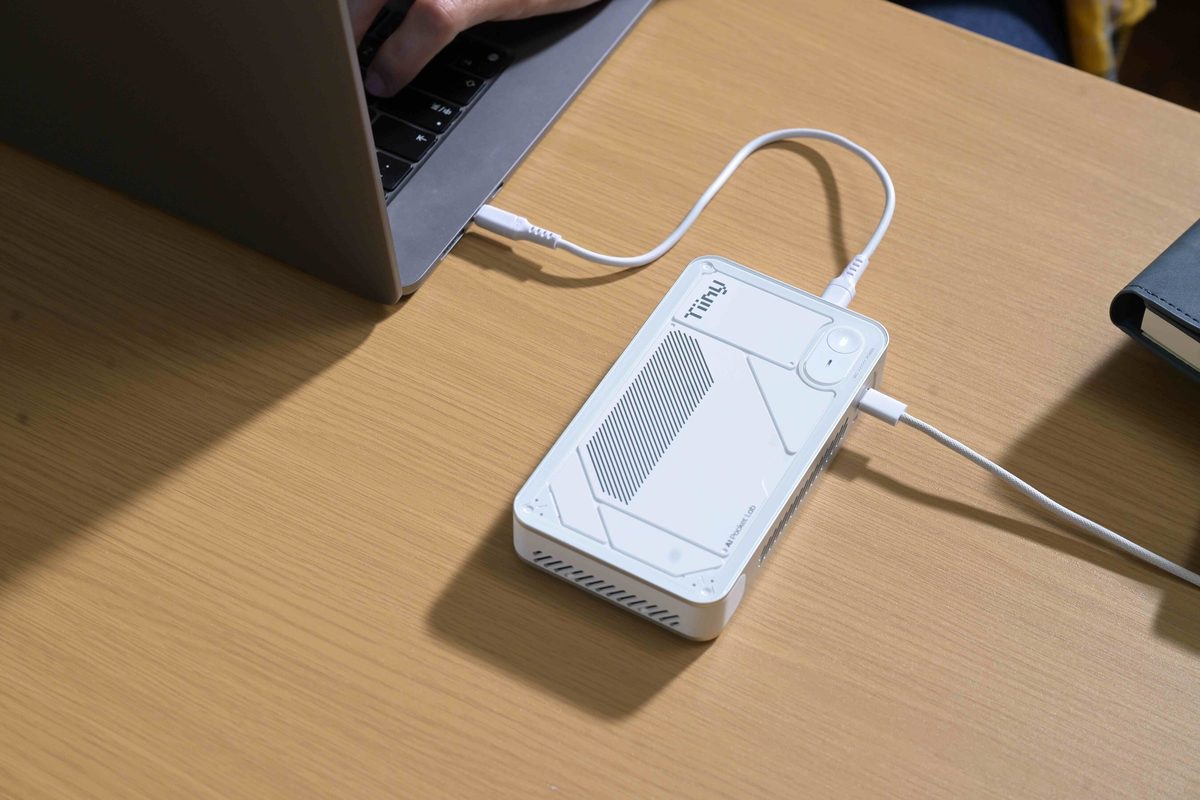
Tiiny AI unveiled the Tiiny AI Pocket Lab, verified by Guinness World Records as the world’s smallest personal AI supercomputer. This device, comparable in size to a power bank, enables local execution of large AI models to address cloud dependency issues, enhancing privacy and accessibility for individual users.
The Pocket Lab measures 14.2 by 8 by 2.53 centimeters and weighs 300 grams, allowing it to fit easily into a pocket or bag. Tiiny AI positions this supercomputer as an option for everyday users, contrasting with other compact devices like NVIDIA’s Project Digits, which costs approximately $3,000, and the DGX Spark, priced at $4,000. These higher price points limit their availability to broader audiences, while the Pocket Lab targets more widespread adoption.
Tiiny AI identifies reliance on cloud infrastructure as the primary limitation in current AI systems, rather than insufficient computing power. The company emphasizes local processing to make AI more personal. GTM director Samar Bhoj states, “intelligence shouldn’t belong to data centers, but to people.” This approach reduces dependence on remote servers, strengthens data privacy by keeping computations on-device, and delivers AI capabilities directly to users without network requirements.
The device supports deployment of large language models reaching up to 120 billion parameters, a scale typically requiring extensive server racks or specialized professional graphics processing units. Such models demand significant resources, yet the Pocket Lab handles them through optimized hardware and software integrations, bringing high-level AI performance to a portable form factor.
At its foundation, the Pocket Lab uses the ARM v9.2 architecture with a 12-core central processing unit. It accommodates various open-source models, including GPT-OSS, Llama, Qwen, DeepSeek, Mistral, and Phi. These models serve diverse applications, from natural language processing to specialized tasks, and the device’s compatibility expands possibilities for developers and researchers working offline.
Central to its operation is a discrete neural processing unit that achieves 190 tera operations per second. This unit pairs with 80 gigabytes of LPDDR5X memory, facilitating aggressive quantization techniques. Quantization compresses model data to lower precision levels, enabling efficient local inference on constrained hardware while preserving essential computational accuracy.
Tiiny AI incorporates two proprietary technologies to enhance performance. TurboSparse employs neuron-level sparse activation, selectively deactivating less critical neural pathways during inference. This method increases efficiency by reducing unnecessary computations, maintaining full model intelligence without quality degradation. PowerInfer functions as a heterogeneous inference engine, distributing AI workloads dynamically between the central processing unit and neural processing unit. This division optimizes resource use, delivering performance comparable to server environments at reduced power consumption levels suitable for portable devices.
The combination of these elements supports applications in research, robotics, and advanced reasoning tasks. Tiiny AI intends to demonstrate the Pocket Lab at CES 2026. Details on pricing and availability remain undisclosed at this stage.