
The Gen X Factor in This Year’s Holiday Shopping Equation
Gen Xers, the powerhouse of the U.S. consumer economy, are cutting back amid current financial challenges, a move that may already be impacting holiday spending.
More than eight in 10 (84%) of these consumers aged roughly 45–60 report facing financial challenges, and only 16% report no concerns, according to data from the latest edition of PYMNTS Intelligence’s “Generational Pulse” report. Our September survey of 2,368 U.S. adult consumers of all ages shows that more than four in 10 (43%) Gen Xers struggle to save and plan for the future. Nearly four in 10 are grappling with housing costs. The overall economic environment, marked by inflation, tariffs and cost of living increases, is a source of worry for 41%, equivalent to about 25 million individuals, according to Census Bureau data.

Research finds that Gen X has been leading consumer spending around the world since 2021 and predicts that dominance lasting through 2033. The global cohort, now in its peak earning years, is expected to account for $15.2 trillion in spending, around one-quarter of the total. Which means that as these higher-spending consumers cut back, the impacts on consumption and broader economy are keenly felt.
Pinching PenniesAmong the more than eight in 10 who report financial challenges, 93% have taken actions to manage or cope with these difficulties. The most common measure is cutting back on everyday spending, which applies to 67% of financially challenged Gen Xers (or nearly six in 10 Gen Xers overall). Next is avoidance of large purchases or investments (52%, or 44% of Gen Xers overall).
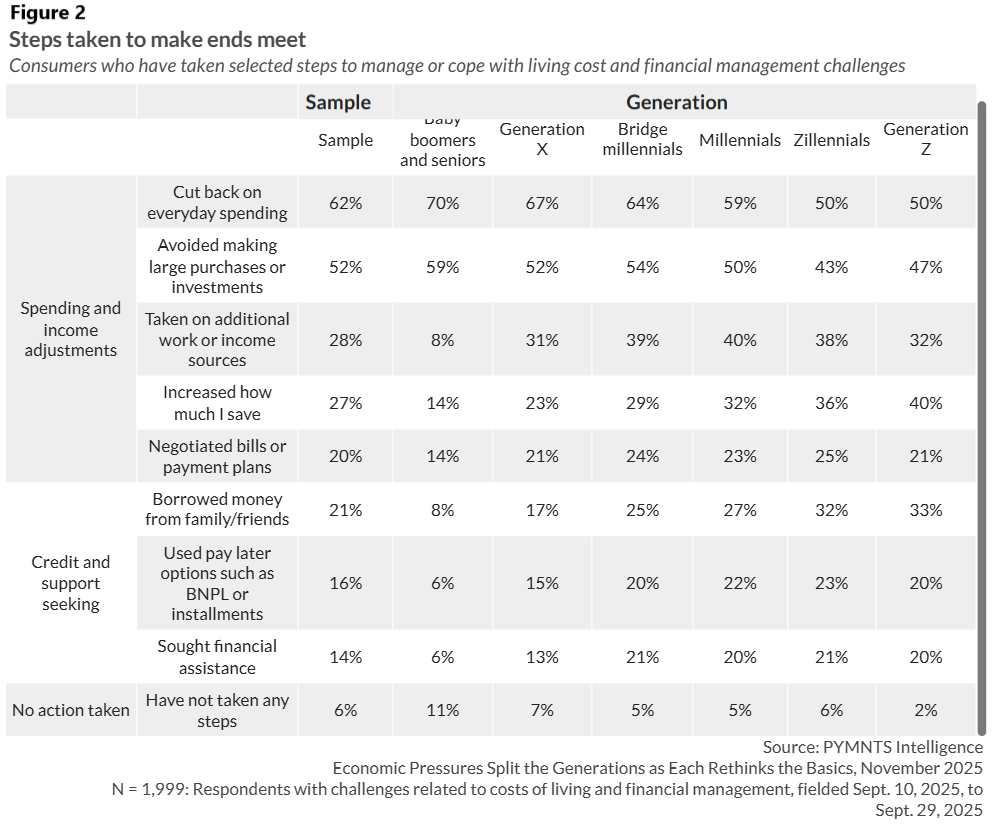
As long as many of these consumers are feeling uncertain about their ability to make ends meet, they will likely continue to be more conservative in their spending. This will be especially true if their belt-tightening actions now fail to make a dent. The study finds that only 30% of Gen Xers say the actions they have taken have been highly effective (versus 34% of consumers overall).
Already, we can see that Gen X holiday-season purchasing is falling off. Another recent PYMNTS Intelligence study, “Black Friday on a Budget: How Discipline and Deals Shaped Holiday Shopping in 2025,” revealed that just two in three Gen Xers bought retail items on Black Friday, slightly below the cross-generational average and a marked decrease from 75% last year. This is an especially important indicator, considering that 27% of consumers do most of their holiday shopping on Black Friday.
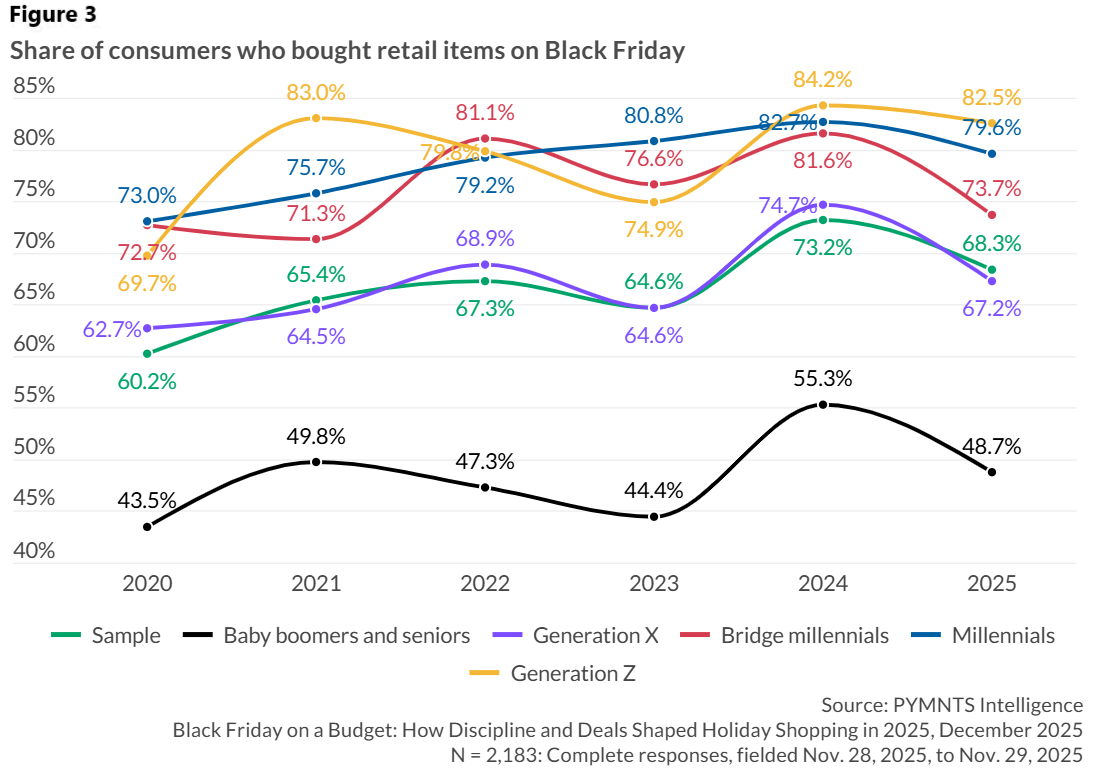
The pullback signals that marketing to this generation requires a highly targeted approach. Gen Xers are less likely than the population-wide average to make shopping decisions based on rewards or loyalty programs, according to the “Black Friday on a Budget” study. They are also less likely to use artificial intelligence to track deals, monitor prices and guide their shopping.
This is not to say they’re uninterested in digital convenience. While Gen X grew up shopping in brick-and-mortar stores, they have adapted to today’s eCommerce landscape. PYMNTS Intelligence research reveals that they are more likely to buy retail products such as clothing, hobby goods, consumer electronics and appliances online than in stores. Moreover, 58% of Gen Xers sometimes or often make purchases based on social media influencer recommendations, especially cooking and tech influencers. And they’re more likely than younger consumers to impulsively buy products on their first encounter with an influencer.
To reach these suggestible consumers, it’s key to know where they spend their time online. Pew Research Center data shows that people aged 50–64 most used social media platforms YouTube and Facebook. Gen Xers also favor traditional media like radio, television and magazines. For instance, the median age of adults who regularly get news from NPR is 48, for CNN it is 50, and for The Atlantic it is 51, according to Pew.
As Gen X tightens its purse strings, the ripple effects are beginning to reshape the holiday retail landscape and may signal broader shifts ahead. This cohort’s financial caution isn’t rooted in reluctance, but in real and persistent economic pressures that are redefining how they spend, save and shop. For retailers and marketers, the message is clear: Winning over Gen X will require relevance, value and strategically placed outreach across both digital and traditional channels.
For more about how consumers’ financial challenges and behaviors differ by generation, delve into the full report, Economic Pressures Split the Generations as Each Rethinks the Basics.
The post The Gen X Factor in This Year’s Holiday Shopping Equation appeared first on PYMNTS.com.