
CES 2026: All the major Qualcomm news and reveals

Qualcomm took the stage at CES 2026 to unveil a massive expansion of its Snapdragon and Dragonwing portfolios, powering everything from next-gen PCs to humanoid robots. The company highlighted a future defined by “physical AI,” showcasing how its chips are driving the transition to software-defined vehicles and intelligent edge computing across every industry.
1. Snapdragon X2 Plus delivers multi-day battery life for Copilot+ PCsQualcomm introduced the Snapdragon X2 Plus, the newest addition to its compute platform designed for Windows 11 Copilot+ PCs. Aimed at modern professionals and aspiring creators, this platform features the 3rd Gen Qualcomm Oryon CPU, which delivers up to 35% faster single-core performance while using 43% less power than the previous generation.
This chipset includes an integrated 80 TOPS NPU to handle advanced AI tasks locally, enabling “agentic” experiences where the PC can act on the user’s behalf. With devices expected to launch in the first half of 2026, the X2 Plus brings Wi-Fi 7 connectivity and enterprise-grade Snapdragon Guardian security to ultra-portable laptops, ensuring users can work for days without reaching for a charger.
 Image: Qualcomm
2. Qualcomm drives momentum with Digital Chassis and agentic AI for cars
Image: Qualcomm
2. Qualcomm drives momentum with Digital Chassis and agentic AI for cars
The company reaffirmed its dominance in the automotive sector, announcing that its Snapdragon Digital Chassis now powers over 75 million vehicles globally. A major highlight was the shift toward “agentic AI,” where vehicles utilize generative AI to proactively anticipate driver needs rather than just reacting to commands.
Qualcomm also revealed the industry’s first commercialized mixed-criticality platform, the Snapdragon Ride Flex, which unifies digital cockpit and driver assistance functions on a single chip. Additionally, to support connectivity as cars transition to advanced networks, Qualcomm launched the A10 5G Modem-RF, the industry’s first automotive 5G RedCap (Reduced Capability) modem designed for cost-effective, mission-critical connectivity.
 Image: Qualcomm
3. ZF and Qualcomm collaborate on scalable ADAS supercomputer
Image: Qualcomm
3. ZF and Qualcomm collaborate on scalable ADAS supercomputer
German automotive supplier ZF and Qualcomm announced a strategic collaboration to deliver a scalable Advanced Driver Assistance System (ADAS) powered by the new ZF ProAI supercomputer. This system integrates the Snapdragon Ride Platform to offer automakers a flexible solution that covers everything from basic regulatory safety functions up to Level 3 automated driving.
The collaboration combines Qualcomm’s high-performance compute hardware with ZF’s expertise in sensors and system integration. By using an open architecture, this solution allows automakers to integrate third-party software and scale their automated driving features across different vehicle lines, accelerating the deployment of safety technologies globally.
 Image: Qualcomm
4. Full suite of robotics technologies powers physical AI and humanoids
Image: Qualcomm
4. Full suite of robotics technologies powers physical AI and humanoids
Qualcomm unveiled a comprehensive robotics architecture and the new Dragonwing IQ10 Series processor, explicitly designed to serve as the “Brain of the Robot” for industrial autonomous mobile robots (AMRs) and full-size humanoids. This platform focuses on “physical AI,” enabling robots to perceive their environment, reason, and adapt to complex tasks in real-world settings.
The company highlighted collaborations with major robotics players like Figure, VinMotion, and Kuka Robotics. By providing a safety-grade, high-performance computing stack, Qualcomm is helping partners move from prototypes to mass deployment in sectors like retail, logistics, and manufacturing.
 Image: Qualcomm
5. Leapmotor debuts world’s first dual-Snapdragon central computer
Image: Qualcomm
5. Leapmotor debuts world’s first dual-Snapdragon central computer
In a major production milestone, Leapmotor and Qualcomm introduced the automotive industry’s first central computer powered by two Snapdragon Elite platforms (dual SA8797P). This high-performance controller will debut in Leapmotor’s flagship D19 vehicle.
This “cross-domain” solution unifies the intelligent cockpit, driver assistance systems, body controls, and gateway into a single unit. By running the Qualcomm Oryon CPU and Hexagon NPU in parallel, the system reduces vehicle complexity and cost while enabling advanced AI workloads, such as multimodal models that handle both driving assistance and passenger interaction simultaneously.
 Image: Qualcomm
6. Google collaboration expands for cloud-to-car innovation
Image: Qualcomm
6. Google collaboration expands for cloud-to-car innovation
Qualcomm and Google announced a massive expansion of their decade-long partnership to streamline the development of software-defined vehicles (SDVs). A key element of this is the new Snapdragon vSoC (virtual System-on-Chip) running on Google Cloud’s Axion bare-metal instances.
This technology allows automakers to design, test, and validate vehicle software entirely in the cloud before hardware is even available, drastically speeding up time-to-market. The partnership also includes a “Unified Reference Platform” aligning Snapdragon Cockpit roadmaps with Android Automotive OS (starting with Android 17) and “Project Treble,” which ensures predictable software updates for 10 years, reducing fragmentation for manufacturers.
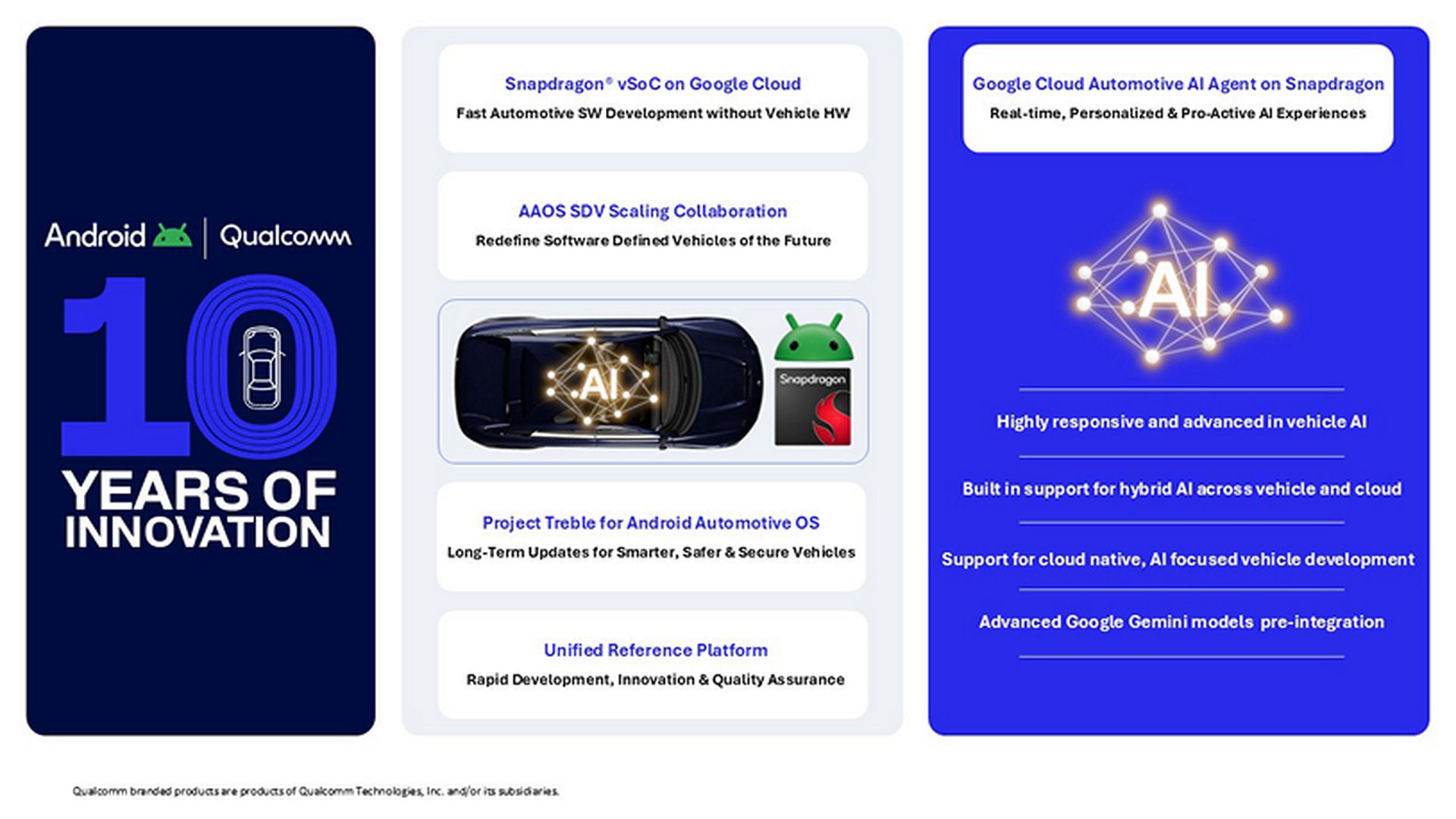 Image: Qualcomm
7. IE-IoT expansion unleashes edge AI for developers and enterprises
Image: Qualcomm
7. IE-IoT expansion unleashes edge AI for developers and enterprises
Rounding out the announcements, Qualcomm revealed a revamped Industrial and Embedded IoT (IE-IoT) portfolio, bolstered by five recent acquisitions including Augentix and Arduino. The company launched the new Dragonwing Q-8750 and Q-7790 processors, designed to bring high-performance edge AI to drones, smart cameras, and media hubs without relying on the cloud.
 Image: Qualcomm
To support this hardware, Qualcomm introduced the “Insight Platform,” a service that uses edge AI and conversational video intelligence to help security teams analyze video feeds in real-time. This comprehensive approach, combined with developer tools from Edge Impulse and Arduino, aims to lower the barrier to entry for building intelligent, connected industrial devices.