
Centralization or Monetary Policy? The Truth Behind InterLink’s Foundation
 Photo by GuerrillaBuzz on Unsplash
If you’re coming from the EVM world, decoding Solana transactions can feel like learning a new language. In Ethereum, you’d use ABIs and tools like ethers.js to decode transaction data. In Solana, the process is different — but once you understand it, it’s just as powerful.
This guide is for:
• EVM developers moving to Solana
• Backend engineers building indexers, bridges, analytics platforms, …
• Anyone decoding on-chain Solana data
I’ll walk you through decoding Solana transaction data using a real-world example: an on-chain auction program (i.e., smart contract). We’ll use the Solana Transaction Parser library from Debridge Finance and learn how to handle custom program instructions that aren’t decoded by default.
Source code: https://github.com/AndreAugusto11/example-usage-solana-parser
Getting StartedBefore we dive in, clone the repository and set up your environment:
git clone https://github.com/AndreAugusto11/example-usage-solana-parser.gitcd example-usage-solana-parser
npm install
You’ll also need TypeScript tooling:
npm install -D typescript ts-nodeRequirements:
- Node.js 18+ (recommended)
- npm
Before we dive into code, let’s understand how transaction decoding differs between these two ecosystems.
The EVM Approach: ABIs and Function SelectorsIn Ethereum and other EVM chains, transaction decoding relies on:
ABIs (Application Binary Interfaces): JSON files that describe contract interfaces, including function signatures, parameter types, and return values. When you call a contract function, your transaction data includes:
0x23b872dd // Function selector (first 4 bytes of keccak256 hash)0000000... // Encoded parameters (ABI-encoded)
Function selectors: The first 4 bytes of the keccak256 hash of the function signature (e.g., transfer(address,uint256)). Tools like ethers.js and web3.js use the ABI to automatically decode these transactions.
The workflow is straightforward:
- Get the contract ABI (from Etherscan or the project)
- Pass it to your library (ethers.js, web3.js)
- The library handles all decoding automatically
Solana’s architecture is fundamentally different. Programs are stateless and transactions can call multiple programs in sequence. This requires a different decoding approach:
IDLs (Interface Description Language): Similar to ABIs, but specific to the Anchor framework (the most popular Solana development framework). An IDL describes:
- Instructions (equivalent to contract functions)
- Accounts (data structures stored on-chain)
- Types and their serialization format
Discriminators: 8-byte identifiers (not 4 bytes like EVM) derived from the sha256 hash of a namespace and name. For instructions, this is global:instruction_name. For accounts, it's account:account_name.
c7385526 92f3259e // 8-byte discriminator (first 8 bytes of sha256)0000000... // Borsh-serialized parameters
The key differences:
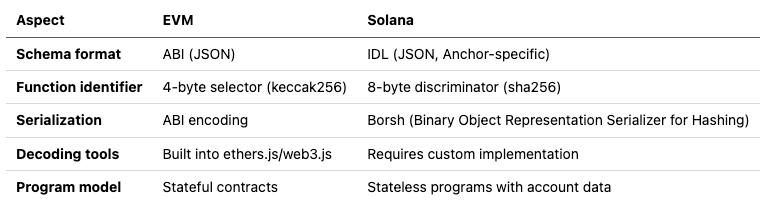 Comparison between EVM and SolanaWhy Solana Decoding is More Manual
In the EVM world, most tools come with built-in ABI decoding. Pass in an ABI, and you’re done. In Solana, while the Anchor framework provides IDLs, you often need to:
- Fetch and fix IDLs: IDLs from explorers may be incomplete
- Calculate discriminators manually: These aren’t always included in IDL files
- Implement custom parsers: The Solana Transaction Parser library doesn’t know about your custom programs
- Handle Borsh serialization: You need to understand the binary layout of your data
This might seem more complex, but it gives you fine-grained control over transaction parsing and a deeper understanding of what’s happening on-chain.
What We’ll BuildIn this tutorial, we’ll decode transactions from Mayan Swift’s auction program (Mayan Swift is a fast bridge between multiple blockchains, serving as a very important piece in the Solana ecosystem, https://docs.mayan.finance/architecture/swift). You’ll learn to:
- Extract and prepare IDL files
- Calculate discriminators for instructions and accounts
- Build a custom decoder that transforms raw buffers into readable data
- Integrate your decoder with the Solana Transaction Parser
By the end, you’ll be able to decode any Anchor-based Solana program’s transactions.
The Problem: Unknown InstructionsNow let’s see this in action. We want to decode data from Mayan Swift’s auction program (9w1D9okTM8xNE7Ntb7LpaAaoLc6LfU9nHFs2h2KTpX1H).
Here’s our starting point — a transaction hash from a bid instruction: Ahy9GEyiPzkrw54Js6rw43bD6m6V3zmDDK6nn6e8N2tskrbkiozhsMjcdBLvCgH5JAc8CFyUZiwWpyCNqQ4wmQb.Feel free to choose another from https://solscan.io/account/9w1D9okTM8xNE7Ntb7LpaAaoLc6LfU9nHFs2h2KTpX1H
Let’s try to parse it without any custom decoders. Create a file src/no-custom-decoder.ts:
import { Connection, clusterApiUrl } from "@solana/web3.js";import { SolanaParser } from "@debridge-finance/solana-transaction-parser";const rpcConnection = new Connection(clusterApiUrl("mainnet-beta"));
const txParser = new SolanaParser([]);const parsed = await txParser.parseTransactionByHash(
rpcConnection,
"Ahy9GEyiPzkrw54Js6rw43bD6m6V3zmDDK6nn6e8N2tskrbkiozhsMjcdBLvCgH5JAc8CFyUZiwWpyCNqQ4wmQb"
);console.log(JSON.stringify(parsed, null, 2));
Run it with:
npx ts-node src/no-custom-decoder.tsThe parser successfully decodes some instructions automatically — the compute budget instructions and system program calls are recognized because they’re common programs already loaded into the parser by default:
[{
name: 'setComputeUnitLimit',
accounts: [],
args: { units: 74200 },
programId: 'ComputeBudget111111111111111111111111111111'
},
{
name: 'setComputeUnitPrice',
accounts: [],
args: { microLamports: 60000 },
programId: 'ComputeBudget111111111111111111111111111111'
},
// ... but then we hit our auction instruction:
{
programId: '9w1D9okTM8xNE7Ntb7LpaAaoLc6LfU9nHFs2h2KTpX1H',
accounts: [ ... ],
args: {
unknown:
},
name: 'unknown'
}
]
That unknown Buffer is your encoded instruction data—255 bytes of Borsh-serialized parameters that the parser can't decode without the program's IDL. This is where our work begins.
Step 1: Get the IDLFirst, fetch the IDL for your program. For Anchor programs, you can find this on Solscan:
Solscan: https://solscan.io/account/9w1D9okTM8xNE7Ntb7LpaAaoLc6LfU9nHFs2h2KTpX1H#anchorProgramIdl
Save the JSON file to src/idl/swift_auction.json.
Step 2: Convert IDL to TypeScriptInstall the Anchor IDL to TypeScript converter, such that the tool can parse its data types:
cargo install simple-anchor-idl-tsRun the converter:
simple-anchor-idl-ts src/idl/swift_auction.jsonThis creates src/idl/swift_auction.ts with TypeScript type definitions.
Step 3: Fix the IDL (Making it Anchor-Compliant)The IDL exported from Solscan is incomplete and won’t work with Anchor’s TypeScript client. We need to fix three critical issues to make it compliant with the Anchor IDL specification. Think of this as the difference between a draft ABI and a production-ready one.
Issue #1: Missing address and metadata fieldsThe Anchor IDL specification requires these fields at the root level, but Solscan’s export omits them. Without these, the Anchor TypeScript client won’t recognize the IDL structure.
Why it matters: The address field ties the IDL to the specific on-chain program, while metadata provides versioning and spec information that tools use for compatibility checks.
At the top of your IDL type definition, add:
export type SwiftAuctionIDLType = {"version": "0.1.0",
"name": "swift_auction",
"address": "9w1D9okTM8xNE7Ntb7LpaAaoLc6LfU9nHFs2h2KTpX1H", // Add this
"metadata": { // Add this
"name": "Swift Auction",
"version": "0.1.0",
"spec": ""
},
"instructions": [
// ...
]
}
Don’t forget to update the corresponding SwiftAuctionIDL object (around line 408) with the same fields.
Issue #2: Missing discriminatorsThis is the critical part. Remember those 8-byte discriminators we discussed earlier? They’re how Solana programs route instructions and identify account types. Without them, we can’t match instruction data to the correct decoder function.
Why it matters: When a transaction comes in with data starting with c7 38 55 26 92 f3 25 9e, we need to know that it maps to the bid instruction. Discriminators make this possible.
Create a helper script calculate-discriminator.js:
const crypto = require('crypto');const name = process.argv[2];if (!name) {
console.log('Usage: node calculate-discriminator.js
process.exit(1);
}const hash = crypto.createHash('sha256').update(name).digest();
const discriminator = Array.from(hash.slice(0, 8));
console.log(`Discriminator: "discriminator": [${discriminator.join(', ')}]`);
Now calculate discriminators for each instruction using the global: namespace:
node calculate-discriminator.js global:bid# Output: "discriminator": [199, 56, 85, 38, 146, 243, 37, 158]node calculate-discriminator.js global:postAuction
# Output: "discriminator": [123, 68, 53, 83, 90, 211, 160, 63]node calculate-discriminator.js global:closeAuction
# Output: "discriminator": [214, 18, 110, 197, 2, 7, 153, 74]node calculate-discriminator.js global:updateConfig
# Output: "discriminator": [102, 77, 158, 235, 28, 216, 191, 121]
And for accounts using the account: namespace:
node calculate-discriminator.js account:auctionState# Output: "discriminator": [110, 220, 44, 10, 38, 234, 132, 215]node calculate-discriminator.js account:auctionTime
# Output: "discriminator": [173, 208, 94, 49, 209, 242, 0, 214]
Add these discriminators to each instruction and account definition in your IDL file. For example:
{"name": "bid",
"discriminator": [199, 56, 85, 38, 146, 243, 37, 158], // Add this array
"accounts": [ ... ],
"args": [ ... ]
}
Pro tip: Notice how the first bytes of our unknown buffer (c7 38 55 26...) match the bid discriminator? That's how we'll route it to the right decoder!
Issue #3: Fix defined type referencesThe IDL converter sometimes generates incorrect type references. The Anchor specification expects a specific format for custom type definitions.
Why it matters: Without the correct format, the TypeScript types won’t compile, and your decoder won’t work.
Find any instances of:
"defined": "OrderInfo"And change them to:
"defined": {"generics": [],
"name": "OrderInfo"
}
This matches the Anchor IDL specification for type references and ensures proper TypeScript type generation.
VerificationAfter these fixes, your IDL should be fully Anchor-compliant. You can verify this by checking that:
- The root object has address and metadata fields
- Every instruction and account has a discriminator array
- All defined types use the object notation
Now we’re ready to build the actual decoder!
Step 4: Build Your Custom DecoderNow comes the exciting part: transforming raw bytes into meaningful data. We’ll build a decoder that mimics how Anchor programs read instruction data on-chain.
Understanding the Decoding StrategyWhen a Solana program receives instruction data, it follows this pattern:
- Read the discriminator (first 8 bytes) to identify which instruction was called
- Deserialize the remaining bytes using Borsh according to the instruction’s argument structure
Our decoder will do the same thing, but in TypeScript rather than Rust.
Setting Up the ParserCreate src/custom-parsers/swift-auction-parser.ts:
import { TransactionInstruction } from "@solana/web3.js";import { SwiftAuctionIDL, SwiftAuctionIDLType } from "../idl/swift_auction";
import {
ParsedIdlInstruction,
ParsedInstruction
} from "@debridge-finance/solana-transaction-parser";
import { decodeOrderInfo } from "../decodeOrderInfo";
import BN from "bn.js";// Extract function selectors (first byte of each discriminator)
// This creates a lookup table: { "bid": 199, "postAuction": 123, ... }
const FUNCTION_SELECTORS = SwiftAuctionIDL["instructions"].reduce((acc, i) => {
acc[i.name] = i.discriminator[0];
return acc;
}, {} as Record
instruction: TransactionInstruction
): ParsedInstruction
// The first byte tells us which instruction this is
const instruction_selector = instruction.data[0];
// Everything after byte 0 is the Borsh-serialized arguments
const remaining_data = instruction.data.slice(1); // Route to the appropriate decoder based on the selector
switch (instruction_selector) {
case FUNCTION_SELECTORS["bid"]:
return decodeBidInstruction(instruction, remaining_data);
case FUNCTION_SELECTORS["postAuction"]:
// You would implement this similarly
throw new Error("postAuction decoder not yet implemented");
// Add more cases for other instructions as needed
default:
throw new Error(`Unknown instruction selector: ${instruction_selector}`);
}
}export { decodeSwiftAuctionInstruction };
What’s happening here:
- We use only the first byte of the discriminator as a selector (in practice, using all 8 bytes is more collision-resistant, but the first byte works for small instruction sets)
- We slice off the first byte and pass the remaining data to instruction-specific decoders
- Each decoder knows the exact memory layout of its arguments
Now let’s implement the decoder for the bid instruction:
function decodeBidInstruction(instruction: TransactionInstruction,
data: Buffer
): ParsedIdlInstruction
return {
name: "bid",
programId: instruction.programId,
// Map instruction accounts to their semantic names
// The order matches the IDL's account definition
accounts: [
{ name: "config", pubkey: instruction.keys[0].pubkey },
{ name: "driver", pubkey: instruction.keys[1].pubkey },
{ name: "auctionState", pubkey: instruction.keys[2].pubkey },
{ name: "systemProgram", pubkey: instruction.keys[3].pubkey },
],
// Decode the arguments according to the IDL structure
args: {
// The 'order' field is a complex struct defined in the IDL
// We need a custom decoder for it (see below)
order: decodeOrderInfo(data),
// The 'amountBid' field is a u64 at the end of the buffer
// Read it as a big-endian 64-bit unsigned integer
amountBid: new BN(data.readBigUInt64LE(data.length - 8)),
}
} as ParsedIdlInstruction
}
Key points:
- Accounts mapping: The IDL tells us each account’s purpose. We map instruction.keys array indices to semantic names
- Argument layout: According to the IDL, a bid instruction has two arguments: order (a struct) and amountBid (a u64)
- Borsh deserialization: The order struct comes first in the buffer, followed by the u64 at the end
The OrderInfo struct contains multiple fields with different types. You'll need to create src/decodeOrderInfo.ts to handle this:
import BN from "bn.js";export function decodeOrderInfo(data: Buffer) {let offset = 0;
// Read each field according to the IDL type definition
// Borsh serializes fields sequentially in declaration order
const trader = Array.from(data.slice(offset, offset + 32));
offset += 32;
const chainSource = data.readUInt16LE(offset);
offset += 2;
const tokenIn = Array.from(data.slice(offset, offset + 32));
offset += 32;
const addrDest = Array.from(data.slice(offset, offset + 32));
offset += 32;
const chainDest = data.readUInt16LE(offset);
offset += 2;
const tokenOut = Array.from(data.slice(offset, offset + 32));
offset += 32;
// Continue for all fields defined in the OrderInfo struct...
const amountOutMin = new BN(data.slice(offset, offset + 8), 'le');
offset += 8;
// ... and so on for the remaining fields
return {
trader,
chainSource,
tokenIn,
addrDest,
chainDest,
tokenOut,
amountOutMin,
// ... other fields
};
}
The pattern:
- Start at offset 0
- Read each field according to its type (u8, u16, u64, [u8; 32], etc.)
- Advance the offset by the field’s size
- Return an object matching the IDL’s type definition
This is exactly how Borsh deserialization works — sequential, fixed-layout reads.
Integrating with the ParserFinally, register your custom decoder with the Solana Transaction Parser. Create src/auction-custom-decoder.ts:
import { Connection, clusterApiUrl } from "@solana/web3.js";import { SolanaParser } from "@debridge-finance/solana-transaction-parser";
import { decodeSwiftAuctionInstruction } from "./custom-parsers/swift-auction-parser";const SWIFT_AUCTION_PROGRAM_ID = "9w1D9okTM8xNE7Ntb7LpaAaoLc6LfU9nHFs2h2KTpX1H";const rpcConnection = new Connection(clusterApiUrl("mainnet-beta"));// Create parser with custom decoder
const txParser = new SolanaParser([
{
programId: SWIFT_AUCTION_PROGRAM_ID,
instructionParser: decodeSwiftAuctionInstruction,
}
]);// Parse the same transaction we tried earlier
const parsed = await txParser.parseTransactionByHash(
rpcConnection,
"Ahy9GEyiPzkrw54Js6rw43bD6m6V3zmDDK6nn6e8N2tskrbkiozhsMjcdBLvCgH5JAc8CFyUZiwWpyCNqQ4wmQb"
);console.log(JSON.stringify(parsed, null, 2));
Run it with:
npx ts-node src/auction-custom-decoder.tsThe parser will now use your custom decoder whenever it encounters an instruction from the Swift Auction program!
Running the ExamplesTo see the difference between parsed and unparsed transactions:
Without custom decoder:
npx ts-node src/no-custom-decoder.tsWith custom decoder:
npx ts-node src/auction-custom-decoder.tsThe second command will show the fully decoded bid instruction with all its parameters visible and readable.
The Result: From Bytes to MeaningLet’s compare what we had before and after implementing our custom decoder.
Before (Unknown Buffer):{programId: '9w1D9okTM8xNE7Ntb7LpaAaoLc6LfU9nHFs2h2KTpX1H',
accounts: [ ... ],
args: {
unknown:
},
name: 'unknown'
}After (Fully Decoded):{
name: 'bid',
programId: '9w1D9okTM8xNE7Ntb7LpaAaoLc6LfU9nHFs2h2KTpX1H',
accounts: [
{ name: 'config', pubkey: '93boUvm9QnkHTa5sUGMuFegLaxYsJQVMrNCAz7HojnY5' },
{ name: 'driver', pubkey: 'B88xH3Jmhq4WEaiRno2mYmsxV35MmgSY45ZmQnbL8yft' },
{ name: 'auctionState', pubkey: 'Cq8nomBLmD4LwrYBA4J3Wk6C4GtcRT72Nb5e1RJcdk8C' },
{ name: 'systemProgram', pubkey: '11111111111111111111111111111111' }
],
args: {
order: {
trader: [0, 0, 0, 0, 0, 0, 0, 0, 0, 0, 0, 0, 43, 90, 122, 111, ...],
chainSource: 30,
tokenIn: [0, 0, 0, 0, 0, 0, 0, 0, 0, 0, 0, 0, 131, 53, 137, 252, ...],
addrDest: [0, 0, 0, 0, 0, 0, 0, 0, 0, 0, 0, 0, 43, 90, 122, 111, ...],
chainDest: 4,
tokenOut: [0, 0, 0, 0, 0, 0, 0, 0, 0, 0, 0, 0, 85, 211, 152, 50, ...],
amountOutMin:
gasDrop:
feeCancel:
feeRefund:
deadline:
addrRef: [0, 0, 0, 0, 0, 0, 0, 0, 0, 0, 0, 0, 165, 170, 110, 33, ...],
feeRateRef: 0,
feeRateMayan: 3, // 0.03% fee
auctionMode: 2, // Dutch auction
keyRnd: [74, 172, 120, 171, 220, 249, 5, 206, ...] // Random key
},
amountBid:
}
}
Now we can see exactly what this transaction does:
- Instruction: A user is placing a bid in an auction
- Accounts: The bid interacts with a specific config, driver, and auction state account
- Parameters:
- The order details show a cross-chain swap from chain 30 to chain 4
2. The minimum output amount is 250 USDC
3. The bid amount is ~250.12 SOL
4. It’s a Dutch auction (mode 2) with a 0.03% Mayan fee
5. Includes deadline, fee structures, and referral information
What We AccomplishedRemember our theoretical comparison at the beginning? We’ve successfully:
- Fetched the IDL (Solana’s equivalent of an ABI)
- Calculated 8-byte discriminators (vs EVM’s 4-byte selectors)
- Implemented Borsh deserialization (vs ABI decoding)
- Built a custom parser (vs automatic ethers.js decoding)
If you’re transitioning from Ethereum to Solana, here are the essential mindset shifts:
1. IDLs vs ABIs: Similar Purpose, Different ImplementationEVM: ABIs are universally supported. Pass one to ethers.js and you’re done.
Solana: IDLs are Anchor-specific and require more manual setup. But this gives you visibility into exactly how data flows through your programs.
2. Discriminators vs Function Selectors: More Bytes, More ContextEVM: 4-byte function selectors from keccak256(functionSignature).slice(0,4)
- Example: transfer(address,uint256) → 0xa9059cbb
Solana: 8-byte discriminators from sha256(namespace:name).slice(0,8)
- Example: global:bid → [199, 56, 85, 38, 146, 243, 37, 158]
The extra bytes reduce collision risk (which has been used in the past in contract exploits) and support namespacing for instructions, accounts, and events.
3. Decoding Tools: Automatic vs ManualEVM ecosystem:
const contract = new ethers.Contract(address, abi, provider);const tx = await contract.populateTransaction.transfer(to, amount);
// Everything decoded automatically
Solana ecosystem:
const txParser = new SolanaParser([customDecoder]);const parsed = await txParser.parseTransactionByHash(connection, hash);
// Custom decoders required for new programs
The Solana approach requires more initial work but teaches you the internals of program communication.
Next StepsNow that you can decode transaction data, you can:
- Build transaction explorers
- Create analytics dashboards
- Build indexers for your dApps
The full source code is available on GitHub: https://github.com/AndreAugusto11/example-usage-solana-parser
Additional Resources:
Welcome to Solana!